Wireless Earbud Specs Explained: A Simple Guide to What Really Matters (2025)
Update on Dec. 12, 2025, 9:59 p.m.
Let’s be honest. Shopping for new wireless earbuds can feel like studying for a test you didn’t prepare for.
You just want something that sounds good and doesn’t die. Instead, you get a face full of confusing numbers and acronyms: Bluetooth 5.3, 13mm Drivers, IPX5, ENC…
What does any of that actually mean for you? Does “5.3” sound better than “5.0”? Is a “13mm driver” good?
It’s overwhelming.
Welcome to the “no-jargon” zone. Think of this as your personal decoder ring for that confusing spec sheet. We’re not going to tell you what to buy, but we are going to teach you how to understand what you’re buying.
We’ll just translate the three most common (and most confusing) specs into plain English.
1. The Connection: What “Bluetooth 5.3” Really Means
The Tech Jargon: Bluetooth 5.3
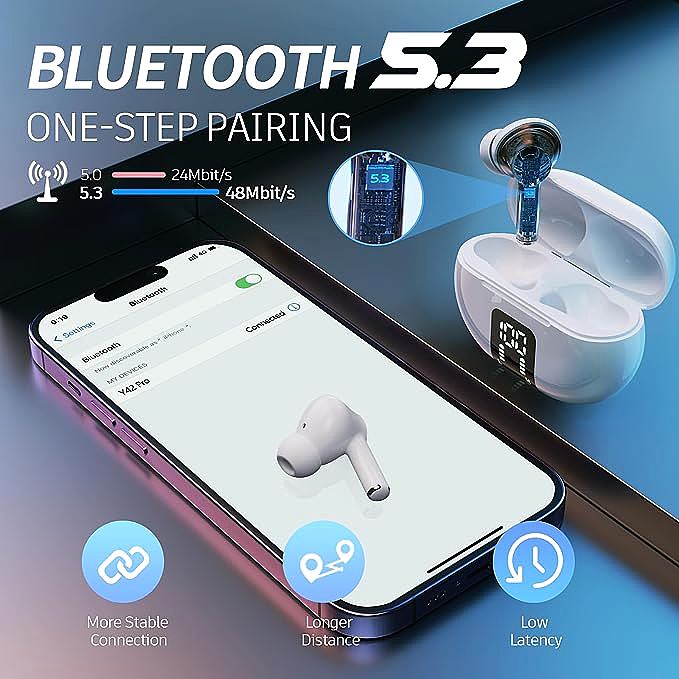
The Plain English Translation: This is the invisible string that connects your phone to your earbuds. “5.3” is simply one of the newest, strongest, and most efficient “strings” available.
You don’t need to know the complex science, but you should know the two real-world benefits:
- It’s More Stable. Think of older Bluetooth (like 4.2) as a string that tangles easily. It works fine in an empty room, but walk through a crowded train station or a busy office (with dozens of other phones, laptops, and Wi-Fi signals), and that “string” gets interference, causing your music to stutter or drop. Bluetooth 5.3 is much, much smarter. It constantly “hops” between channels to find the clearest path, meaning a far more stable connection in busy areas.
- It’s More Efficient. This is a big one. Bluetooth 5.3 is built on “Low Energy” (LE) technology. For you, this means it sips battery power from your phone and your earbuds, instead of gulping it. This is how manufacturers can get 5, 6, or even 7 hours of playtime out of a single charge.
The Bottom Line: You don’t need to hunt for 5.3 specifically, but seeing it on a spec sheet (like on the Carego Y42 Pro, for example) is a great sign. It’s a modern standard that ensures your connection will be more reliable and your battery will last longer.
2. The Sound: What “13mm Driver” Means
The Tech Jargon: 13mm Dynamic Driver
The Plain English Translation: The “driver” is just the tiny speaker inside the earbud that actually makes the sound. “13mm” refers to its diameter.
Think of it this way: a tiny ukulele string can make a high-pitched “plink,” but you need the big, thick string on a bass guitar to make a deep, rumbling “thump.”
It’s the same with physics and sound. To create powerful, deep bass, you need to move a lot of air.
- Small Drivers (e.g., 6mm-8mm): These can be amazing for clarity and detail, especially in vocals and high-pitched instruments.
- Large Drivers (e.g., 10mm-13mm+): A larger surface (like 13mm) can physically push more air. This often translates to a fuller, warmer sound with more powerful and noticeable bass.
This is why you’ll often see larger drivers advertised on earbuds aimed at listeners of Pop, Hip-Hop, or EDM. It’s not a guarantee of “better” sound (the tuning matters a lot!), but it’s a very strong indicator of the type of sound it’s built for: full, warm, and bass-friendly.
3. The Durability: What “IPX5” Really Means
The Tech Jargon: IPX5 Waterproof
The Plain English Translation: This is simply a durability rating that tells you how well the earbuds are protected against water. It’s the most important spec to check if you plan to exercise or walk in the rain.
Let’s decode “IPX5”:
- IP: Stands for “Ingress Protection” (a fancy term for “keeping stuff out”).
- X: This first part rates protection against solids (like dust). “X” just means it wasn’t tested for that. This is normal for earbuds.
- 5: This is the number that matters. It rates protection against liquids.
Here’s a simple cheat sheet:
- IPX4: Splash-proof. It can handle sweat from a light workout or a light drizzle.
- IPX5: (This is the sweet spot). It’s protected from “low-pressure water jets from any direction.” In the real world, this means it can easily handle heavy sweat from an intense run and survive being caught in a rainstorm.
- IPX7: Waterproof (Submersible). Can be dropped in 1 meter of water for up to 30 minutes.
The Bottom Line: For 99% of users, IPX5 is more than enough. It gives you complete peace of mind for workouts and all-weather commuting. But does it mean you can wear them in the shower? No. A shower is “high-pressure” water, and the soap and heat can damage the seals. IPX5 is for sweat and rain, period.
You’re a Smarter Shopper Now
That’s it. You’ve just learned the three most important specs.
You now know that: * Bluetooth 5.3 means a stable, power-sipping connection. * A 13mm Driver is a good sign if you love bass. * IPX5 means “yes” to sweat and rain, but “no” to swimming or showering.
See? No advanced degree required. You can now look at any spec sheet and understand, in plain English, what you’re really getting for your money.