Gravity vs. Geometry: The Biomechanics of Sport Earbuds
Update on Dec. 13, 2025, 10:50 a.m.
In the domain of sports audio, the primary adversary is not poor frequency response, but gravity. As a runner’s foot strikes the pavement, the resulting impact force travels up the kinetic chain, causing the head to oscillate. For an earbud to remain seated during this violent motion, it must rely on friction and mechanical leverage. The jechan K18-x Wired Earbuds adopt a specific form factor—the over-ear hook design—to combat these forces. This article dissects the mechanical and acoustic principles that define this category of budget-friendly sports gear, distinguishing between successful engineering and potential points of failure.
The Cantilever Effect of Ear Hooks
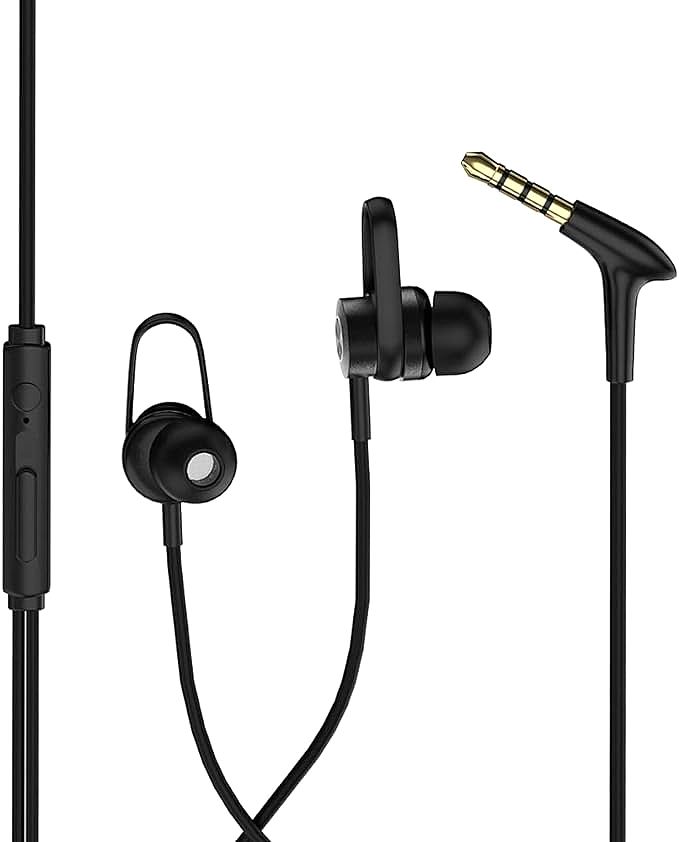
Standard earbuds rely solely on the friction between the silicone tip and the ear canal (the external auditory meatus) to stay in place. This interface is notoriously unstable; sweat acts as a lubricant, reducing the coefficient of friction, while the cable’s weight creates a downward drag force. The K18-x mitigates this through its integrated ear hooks. From a mechanical standpoint, the hook creates a cantilever system. The top of the pinna (the outer ear) serves as a fulcrum. The weight of the cable, which would normally pull the earbud out, is instead redistributed across the top of the ear.
This design theoretically decouples the cable’s mass from the ear tip seal. When the user moves, the cable tugs on the hook, not the seal. However, the effectiveness of this system depends entirely on the material compliance. A hook that is too rigid creates pressure points, leading to cartilage fatigue and pain over long durations. A hook that is too soft fails to provide the necessary counter-force. User reports regarding the K18-x suggest a “soft” hook design, aiming for comfort, but this introduces a variable: users with smaller or larger-than-average ears may find the fixed geometry of the hook does not align perfectly with their anatomy, leading to the stability issues cited in some negative reviews.
The Physics of Passive Noise Isolation
The K18-x marketing claims “noise isolation,” a term often confused with “active noise cancellation” (ANC). Understanding the difference is crucial. ANC uses microphones and inverted phase waves to cancel out low-frequency drones. The K18-x employs Passive Noise Isolation (PNI), which is essentially physical blocking. The efficacy of PNI is determined by the acoustic impedance mismatch between the blocking material (the silicone tip) and the air.
When a proper seal is achieved using the correct size ear tip (S/M/L), the ear canal becomes an acoustically isolated chamber. This isolation blocks high-frequency sounds—like the clanking of weights or chatter—more effectively than many budget ANC systems. Furthermore, this seal is vital for the “Super Bass” performance advertised. If the seal is broken (a “leak”), the low-frequency pressure waves generated by the driver escape into the environment rather than pressurizing the eardrum. This results in a tinny, hollow sound. Therefore, the user’s ability to select the correct tip size is not just a comfort decision; it is a calibration step for the device’s frequency response.

Magnetic Management and Cable Dynamics
One often overlooked aspect of wired headphone mechanics is cable management. The K18-x features magnetic earpieces that snap together. While convenient for wearing the device like a necklace, this feature addresses a specific entropy problem: cable tangling. Tangling is mathematically inevitable for loose cables in a pocket (knot theory). By creating a closed loop via the magnets, the degrees of freedom for the cable are reduced, significantly lowering the probability of knot formation.
However, the cable itself introduces “microphonics”—the phenomenon where mechanical vibrations (from rubbing against a shirt) travel up the wire and are audible as thumping or scratching sounds in the ear. The over-ear hook design of the K18-x acts as a mechanical damper for these vibrations. By routing the cable behind the ear, the contact point with the skin absorbs much of this vibrational energy before it reaches the driver housing, resulting in a cleaner audio experience during movement compared to straight-down cable designs.
Failure Modes in Biomechanical Interfaces
Despite the sound theoretical design, the real-world application often faces hurdles. The interface between the ear hook and the earbud housing is a stress concentration point. In budget manufacturing, the bonding agents or plastic welds used here are often the first to fail under the repetitive strain of putting the headphones on and taking them off. Additionally, the universality of the “universal fit” is a statistical approximation. Human ears vary wildly in shape. For a subset of the population, the fixed curvature of the K18-x hook will simply never align with their helix root, rendering the stabilization mechanics useless. This aligns with the polarized customer reviews: for those whom it fits, the mechanics work perfectly; for those it doesn’t, gravity wins.
In conclusion, the jechan K18-x leverages the mechanical advantages of the ear hook design to solve the stability problems inherent in sports audio. By utilizing leverage and passive sealing, it attempts to deliver consistent sound and isolation without the need for electronic complexity. Its success, however, is strictly bound by the compatibility between its fixed geometry and the user’s unique biological anatomy.