The Path of Purity: Monocrystalline Cables and Acoustic Ergonomics
Update on Jan. 4, 2026, 11:20 a.m.
In the audiophile equation, the cable is often the variable of greatest contention. Skeptics call it “snake oil”; believers call it a vital component. However, when we look at the physics of electrical transmission at a microscopic level, the differences become tangible.
The FiiO FH1s comes with a “High purity monocrystalline Litz cable.” This is not just a bundle of wires; it is a carefully engineered transmission line designed to preserve the integrity of the analog signal. This article explores the metallurgy of copper, the physics of the “skin effect,” and the ergonomic craftsmanship of the IEM shell.
Metallurgy of Sound: Monocrystalline Copper
Standard copper wire, used in lamp cords or cheap earbuds, is polycrystalline. It consists of millions of copper crystals packed together. * Grain Boundaries: Between each crystal is a boundary. At the atomic level, these boundaries are imperfections. They can act as tiny barriers to electron flow, increasing resistance and potentially causing non-linear distortion to the delicate audio signal. * The Monocrystalline Solution: The FH1s cable uses OCC (Ohno Continuous Casting) or similar processes to draw the copper wire. This technique produces extremely long crystals—a single crystal can span meters of wire. By virtually eliminating grain boundaries, the wire offers a “superhighway” for electrons. The result is lower resistance and, theoretically, cleaner signal transmission, particularly for micro-details in the music.
The Physics of Litz: Combating the Skin Effect
The cable is described as having “120 braided individual… Litz wires.” What is Litz?
When an alternating current (like an audio signal) flows through a wire, it generates a magnetic field. This field pushes the electrons towards the surface of the wire.
* Skin Effect: As frequency increases, the current density concentrates more and more at the “skin” of the conductor. The center of the wire becomes dead weight. This effectively increases the resistance of the wire for high frequencies (treble), potentially causing signal roll-off.
* The Litz Solution: Litz wire consists of many thin, individually insulated strands woven together. This forces the current to use the entire cross-section of the cable, regardless of frequency. By mitigating the skin effect, the FH1s cable ensures that the high-frequency extension provided by the Knowles BA driver reaches the ear without attenuation. It maintains the “air” and “sparkle” of the recording.
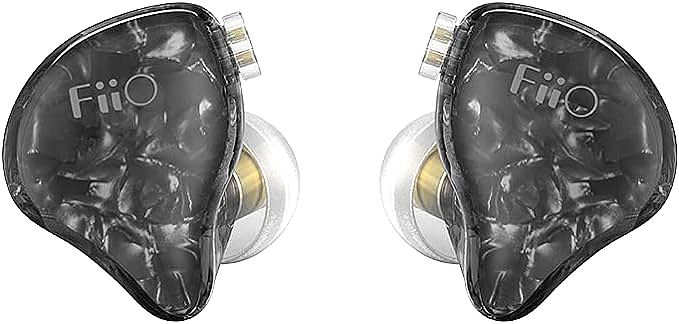
Material Aesthetics: The Celluloid Faceplate
The FH1s features a faceplate made of Celluloid. This is a material steeped in history—the first synthetic plastic, once used for movie film and guitar picks. * Aesthetic Randomness: The layering process of celluloid creates organic, swirling patterns. No two units are exactly alike (“giving each FH1s its own custom look”). In an age of mass-produced injection molding, this adds a layer of bespoke craftsmanship. * Acoustic Properties: Unlike brittle acrylics or ringing metals, celluloid has a natural warmth and damping quality. While primarily decorative here, the choice of shell material in IEMs always contributes to the resonance characteristics of the back chamber. A well-damped shell prevents the plastic “thrum” that can color the lower midrange.
The Ergonomics of Custom-Universal Fit
The shape of the FH1s is described as “ergonomic.” This usually means a “Custom-Universal” design. * Anthropometric Data: FiiO likely utilized a database of thousands of ear impressions to design a shell shape that mimics the contours of a custom-molded IEM but fits 95% of the population. * The Concha Lock: The shell fills the concha of the ear, distributing weight across the cartilage rather than hanging from the ear canal. This, combined with the over-ear cable design, eliminates the “stethoscope effect” (microphonics) where cable noise travels into the ear. The cable acts as a suspension bridge, carrying the weight and absorbing shock.
Conclusion: The Complete Package
The FiiO FH1s demonstrates that “budget” does not have to mean “cheap.” By incorporating monocrystalline Litz cables and Knowles drivers, FiiO brings technologies previously reserved for $200+ IEMs down to an accessible price point.
It respects the signal from start to finish—from the low-resistance path of the cable to the phase-coherent output of the drivers. It is a device that invites the listener to stop hearing the equipment and start hearing the music.