The Democracy of Bass: How Budget Audio Caught Up with the Giants
Update on Jan. 4, 2026, 12:10 p.m.
For decades, the audio industry was stratified. If you wanted “good sound,” you paid hundreds of dollars. If you paid $30, you got tinny, distorted garbage that sounded like it was playing through a tin can. This was the accepted order of things.
But something shifted in the last few years. We entered the era of Audio Democratization. Devices like the WUYI Q61 Wireless Earbuds are disrupting the hierarchy, offering features—graphene drivers, Bluetooth 5.3, IP7 waterproofing—that were flagship-exclusive just five years ago.
This article explores the economic and technological forces behind this shift. How did “budget” become “good”? Why does a $30 pair of earbuds now follow the same acoustic curve as a $200 pair? And what does this mean for the future of how we consume sound?
The Standardization of the “Harman Curve”
One of the biggest secrets in audio is that “good sound” is no longer a mystery; it’s a formula.
In the past, tuning a headphone driver was a dark art. Now, we have the Harman Curve. Extensive research by Harman International identified a specific frequency response profile that the vast majority of listeners prefer: slightly boosted bass, a flat midrange, and a gentle roll-off in the highs.
DSP: The Great Equalizer
In the analog days, achieving this curve required expensive physical engineering of the driver and housing. Today, it is largely achieved through DSP (Digital Signal Processing).
The tiny chips inside the WUYI Q61 don’t just receive Bluetooth signals; they actively EQ the sound before it hits the driver. They can boost the bass and smooth out the treble peaks digitally.
This means that even affordable hardware can be tuned to match the “Target Curve” of premium brands. The Q61 delivers that punchy, energetic sound signature not because it uses magic materials (though graphene helps), but because it uses smart math. It gives the people exactly what they biologically crave: rhythm and clarity.
The Supply Chain Singularity
The Q61 is a beneficiary of the Shenzhen Effect. The components that make up a TWS (True Wireless Stereo) earbud—the Bluetooth SoC (System on Chip), the Lithium-polymer micro-battery, the MEMS microphone—have become commodities.
- Bluetooth 5.3 Chips: Once cutting-edge, these are now mass-produced by companies like Realtek and Airoha for pennies. They offer the same stability and range as the chips in much more expensive buds.
- Graphene Drivers: The manufacturing process for graphene-coated diaphragms has scaled up, moving it from the lab to the factory floor.
Because these core components are standardized and abundant, a brand like WUYI can assemble a device with “Flagship Specs” at a fraction of the “Flagship Price.” The cost savings aren’t coming from cutting corners on the chip; they’re coming from the lack of a billion-dollar marketing budget and a celebrity endorsement.
The Feature Trickle-Down: Visualizing Value
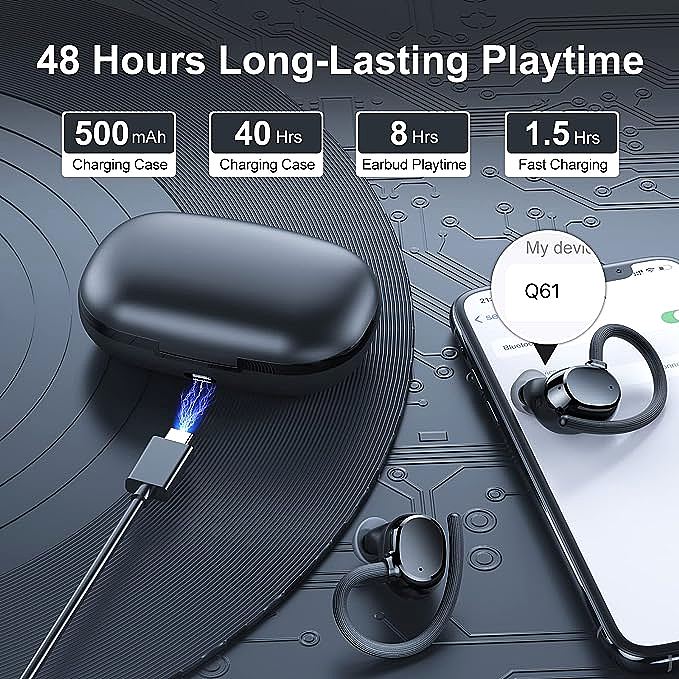
Perhaps the most striking example of this democratization is the LED Digital Display on the Q61’s case.
Ironically, premium brands (Apple, Sony, Bose) rarely offer this. They stick to a single, minimalist LED dot that changes color (Green/Amber/Red). This is “elegant,” but functionally vague.
Budget brands, fighting harder for attention, embraced Radical Utility. They put actual screens on the case. They give you the data: “56% left.”
This feature, once seen as “gimmicky,” is now recognized as superior UX (User Experience). It solves a real problem (battery anxiety) better than the expensive competition. It proves that innovation isn’t just about new tech; it’s about applying existing tech (LED digit displays) in useful ways.
The Psychological Shift: Disposable vs. Durable
There is, however, a shadow side to this democracy. At $30, earbuds risk becoming “disposable tech.”
If a $250 pair of AirPods breaks, you try to repair it. If a $30 pair of Q61s breaks after two years, you likely buy a new pair.
However, the Q61 counters this narrative with its IP7 Waterproofing. By building the device to withstand sweat, rain, and accidental drops in the sink, WUYI extends the functional lifespan of the product. It is built to be a “beater”—a device you can abuse in the gym without fear.
This creates a new category of value: Stress-Free Ownership. You can enjoy your music intensely, sweating profusely, running in the rain, without the nagging fear of ruining a luxury investment.
Conclusion: The End of the Gatekeepers
The WUYI Q61 is more than a bargain; it is a signal. It signals that the gatekeepers of high-fidelity audio have fallen.
The barriers to entry—latency, battery life, tuning, and build quality—have been lowered by the tide of global technological progress. We can now get 48 hours of battery, rock-solid connectivity, and scientifically pleasing sound for the price of a takeout dinner.
This is the democracy of bass. And in this new world, everyone gets a front-row seat.