The Physics of Silence: Decoding 30dB Reduction and Acoustic Sealing
Update on Jan. 4, 2026, 12:11 p.m.
In the cacophony of the modern world, silence has become a luxury good. The roar of jet engines, the rumble of subway trains, and the hum of open-plan offices create a constant background radiation of noise that taxes our cognitive resources. We are tired not just from work, but from processing sound.
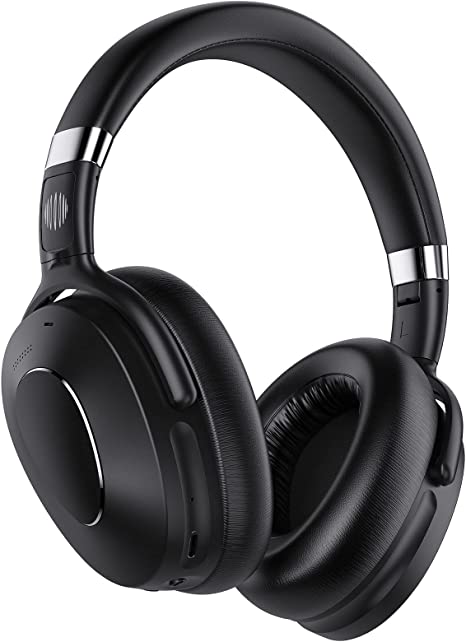
Historically, the technology to reclaim this silence—Active Noise Cancellation (ANC)—was the exclusive domain of business class travelers and audiophiles willing to pay a premium. Brands like Bose and Sony built empires on this exclusivity. However, the Status SAANC-CE-CLOUD-NEW Core ANC Headphones represent a pivotal moment in the audio industry: the democratization of silence.
By offering substantial noise reduction capabilities without the “brand tax,” these headphones invite us to look past the logo and focus on the physics. How does a device effectively erase sound? What does “30dB reduction” actually mean in terms of energy? And why is a piece of vegan leather just as important as the microchips inside? To understand the value of the Status Core ANC, we must first understand the science of sound itself.
Stratum I: The Mathematics of “Minus 30dB”
Marketing materials often throw around decibel (dB) numbers as if they were linear scores—like points in a basketball game. But sound doesn’t work that way. The decibel scale is logarithmic.
The Power of Logarithms
The Status Core ANC claims a noise reduction of “up to 30 decibels.” To the uninitiated, 30 might seem like a modest number. But in acoustics, it is massive. * 10dB reduction: Represents a 10-fold decrease in sound intensity. Subjectively, it sounds “half as loud.” * 20dB reduction: Represents a 100-fold decrease in sound intensity. * 30dB reduction: Represents a 1,000-fold decrease in sound intensity.
When these headphones engage their ANC circuit, they are effectively attenuating 99.9% of the acoustic energy in specific frequency bands before it reaches your perception. This is not just “turning down the volume”; it is an act of energetic suppression.
The Mechanism of Destructive Interference
How is this achieved? The principle is called Destructive Interference. Sound travels as a wave, a series of compressions (peaks) and rarefactions (troughs) in the air.
1. Sampling: Microphones on the exterior of the Status Core ANC “listen” to the ambient noise (e.g., the drone of an airplane engine).
2. Inversion: The internal Digital Signal Processor (DSP) instantly analyzes this wave and generates a mirror image—an “anti-noise” wave. Where the noise wave peaks, the anti-noise wave troughs.
3. Cancellation: The headphones play this anti-noise wave through the drivers. When the ambient noise wave meets the anti-noise wave, they collide. The positive pressure of the noise is neutralized by the negative pressure of the anti-noise. Mathematically, +1 plus -1 equals 0.
The result is silence. Or, more accurately, a dramatic reduction in the noise floor. This technology is particularly effective against low-frequency, repetitive sounds (like engines) because their waveforms are predictable, giving the DSP ample time to calculate the inverse wave.
Stratum II: The Fortress of Solitude (Passive Isolation)
However, ANC has a weakness: High Frequencies. Sudden, sharp sounds like a crying baby, a glass breaking, or human speech happen too quickly and are too complex for the anti-noise algorithm to cancel perfectly in real-time.
This is where the physical design of the headphone becomes the primary line of defense. We call this Passive Noise Isolation.
The Acoustic Seal
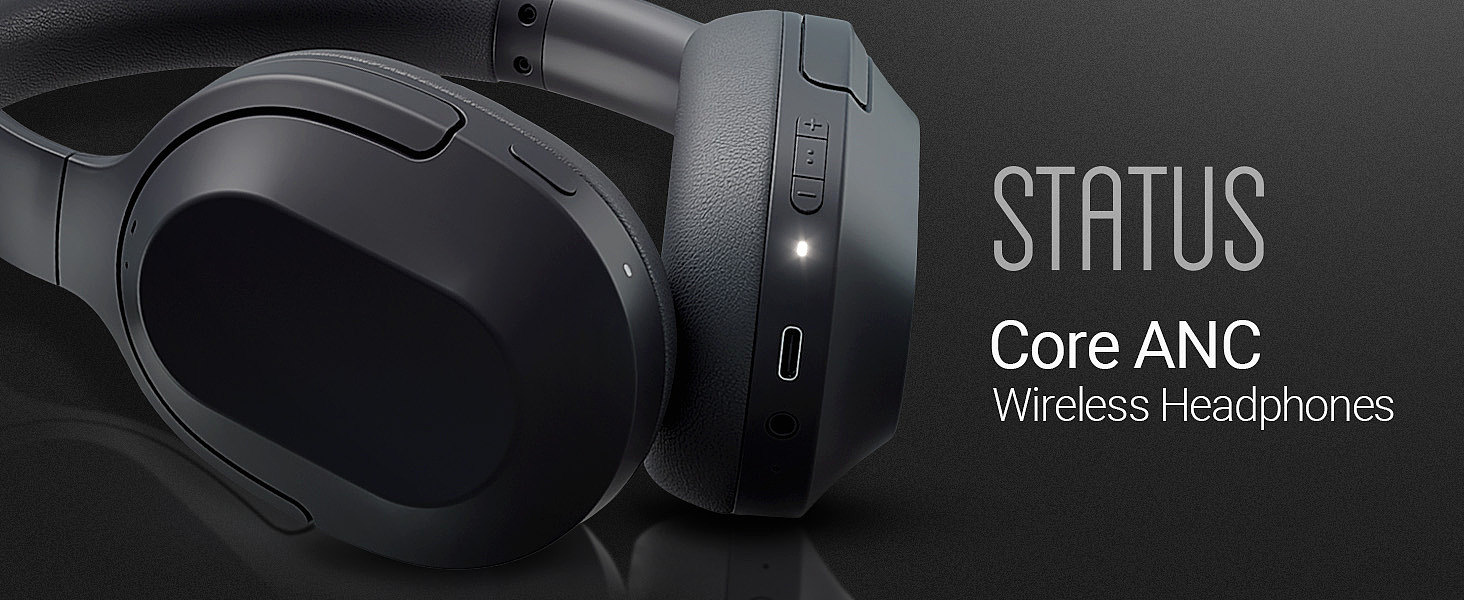
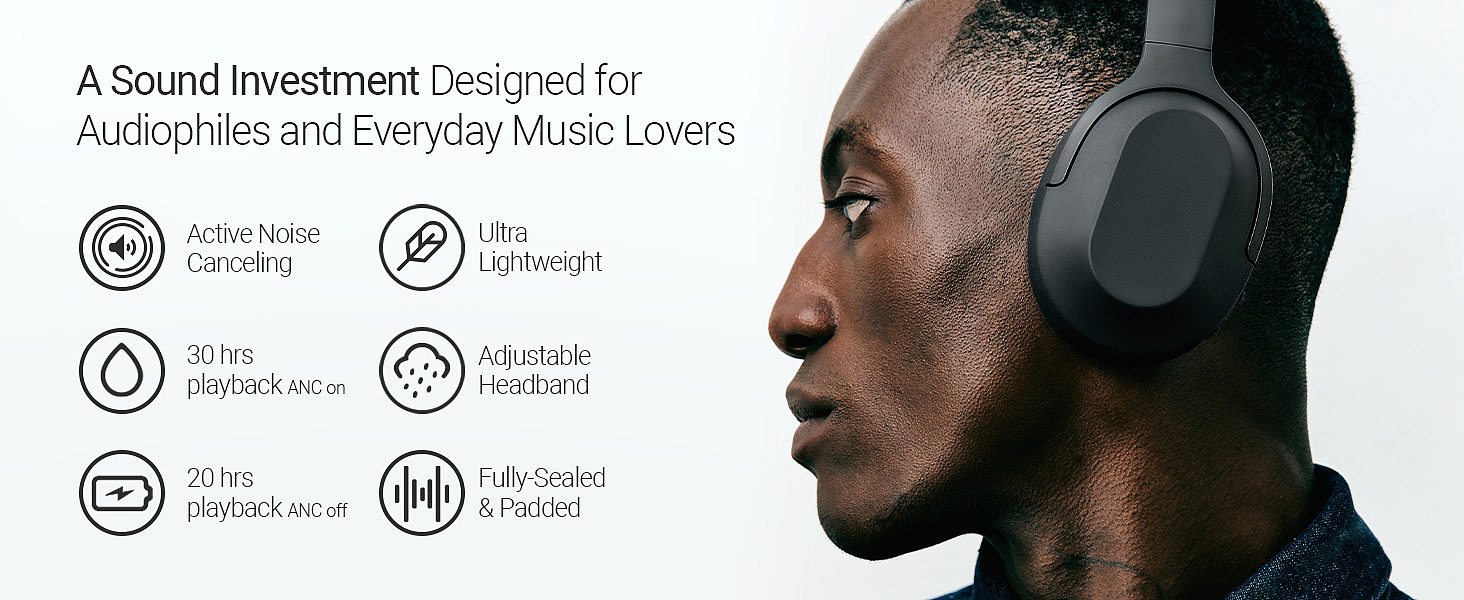
The Status Core ANC features “plush vegan-leather earpads.” While this sounds like a comfort feature, it is actually a critical acoustic component. The goal is to create a hermetic seal around the ear. * Material Density: The foam inside the pads must be dense enough to absorb sound energy but compliant enough to mold to the irregular shape of the jaw and skull. * Skin Effect: The “vegan leather” (likely a high-grade protein leather) is non-porous. Unlike fabric, which lets air (and sound) pass through, leather blocks airflow.
This seal transforms the ear cup into an acoustic chamber. It physically reflects high-frequency sound waves away from the ear canal. In engineering terms, the ear pads act as a Low-Pass Filter, blocking high frequencies while the ANC electronics handle the low frequencies. The two systems work in a relay race: Passive Isolation takes the baton for the highs, and Active Cancellation takes it for the lows. Without this physical seal, the 30dB ANC performance would be wasted, leaking out into the air.
Stratum III: The Energy Economics (Battery Physics)
Silence consumes energy. Creating anti-noise requires the DSP to run calculations thousands of times per second and the amplifier to drive the speakers to push air.
The Status Core ANC offers a revealing spec: * 30 Hours of playback with ANC OFF. * 20 Hours of playback with ANC ON.
That 10-hour difference is the Energy Tax of silence. It is the cost of computation. This metric is crucial for the user to understand. It turns battery management into a strategic decision.
If you are sitting in a quiet library, turning ANC on is a waste of 33% of your battery life. The passive isolation alone is likely sufficient.
If you are on a transatlantic flight, that 33% tax is the best investment you can make. The reduction in low-frequency rumble lowers cortisol levels and reduces fatigue, making the energy cost negligible compared to the physiological benefit.
Stratum IV: The Hybrid Utility (Wired Redundancy)
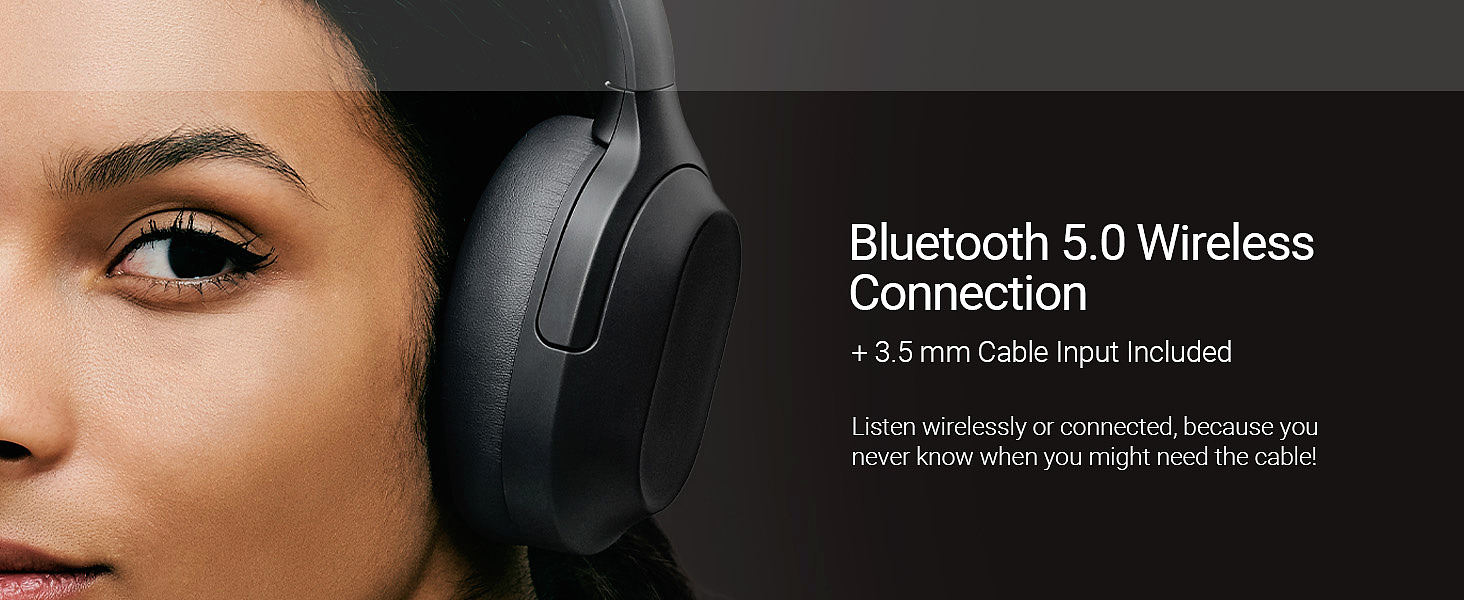
We live in a wireless world, but the laws of physics still favor the wire. The Status Core ANC includes a 3.5mm jack, a feature that is disappearing from many flagship devices but remains essential for versatility.
The Fail-Safe Protocol
Batteries die. Lithium-ion chemistry is finite. In a pure wireless headset, a dead battery means a dead device. It becomes a paperweight.
With the 3.5mm jack, the Status Core ANC retains Passive Utility. Even with zero charge, you can plug them in and listen. The ANC won’t work (as it requires power), but the passive isolation and the drivers will still function. This “Fail-Safe” design is a hallmark of professional gear, ensuring that the user is never left without audio.
The Latency Question
Bluetooth 5.0 is fast, but it is not instant. For watching movies or listening to music, a 150ms delay is acceptable. For gaming or video editing, it is disjointing. The wire offers Zero Latency (speed of light). It connects the user directly to the source, bypassing the encoding/decoding chain. For the multimedia creator on a budget, this dual-mode capability—wireless for the commute, wired for the edit—makes the headphones a versatile tool rather than just a consumption device.
Conclusion: Silence as a Utility
The Status SAANC-CE-CLOUD-NEW Core ANC Headphones strip away the mystique of high-end audio. They present silence not as a luxury wrapped in marketing, but as a utility derived from physics.
By combining the destructive interference of active cancellation with the physical barrier of passive isolation, they achieve a level of quiet that was once priced out of reach for the average consumer. They remind us that the principles of acoustics are universal. Sound waves don’t care about the logo on the ear cup; they only care about the phase inversion and the seal. For the pragmatic listener, this is the only truth that matters.