Heavy Metal: The Material Science of Catfish Reels
Update on Feb. 1, 2026, 3:22 p.m.
In the hierarchy of fishing gear, there are finesse tools and there are brute force tools. A bass reel is like a sports car—light, fast, and precise. A catfish or musky reel, however, must be a bulldozer. It operates in a world of high torque, heavy loads, and gritty environments. In this domain, the primary design constraint is not weight; it is Yield Strength.
When a 40-pound blue catfish decides to dive into a log jam, the forces applied to the reel’s internals are immense. This is where material science becomes the difference between a landed fish and a pile of broken plastic. The “Round Reel” form factor has survived for decades not because of nostalgia, but because its cylindrical geometry and metallic construction offer the highest structural integrity of any reel design.
Stress Analysis in High-Torque Scenarios
Consider the forces at play when cranking against a heavy load. The handle acts as a lever, transmitting torque to the main gear. The main gear meshes with the pinion gear, which turns the spool.
If the reel’s body (the frame) flexes even a fraction of a millimeter under this load, the gears become misaligned. The teeth no longer mesh perfectly. Instead of distributing the load across the entire face of the gear tooth, the force concentrates on the tip. This leads to “gear shearing”—stripping the teeth right off the gear. This is why plastic or graphite frames, while light, are often unsuitable for heavy-duty work. They lack the stiffness to maintain gear alignment under high stress.
Anodized Aluminum: The Chemical Shield
To solve the flex problem, you need metal. But steel rusts, and raw aluminum corrodes, especially in saltwater or brackish environments where catfish often roam. The solution is Hard Anodized Aluminum.
Anodizing is an electrochemical process that converts the metal surface into a decorative, durable, corrosion-resistant, anodic oxide finish. Unlike paint, which sits on top, the oxide is integrated with the underlying aluminum substrate. This creates a shell that is nearly as hard as diamond. It protects the reel from the galvanic corrosion that occurs when dissimilar metals (like steel bearings and aluminum frames) interact in the presence of an electrolyte (water).
Case Study: The Red Metal Tank
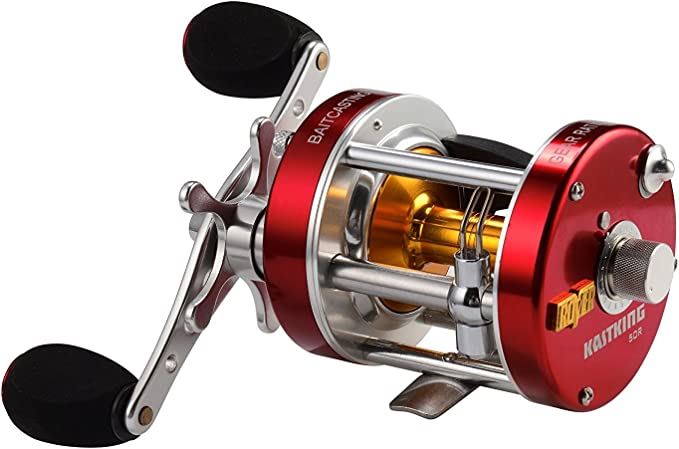
The KastKing Rover is a study in this material philosophy. Its side plates and spool are machined from reinforced anodized aluminum. This isn’t just for the striking red look; it’s a structural choice.
By using thick-walled aluminum side plates, the Rover creates a rigid housing for the drive train. When you crank down on the star drag, the frame doesn’t twist. This rigidity ensures that the stainless steel worm shaft and the brass gears remain in perfect mesh, transferring 100% of your energy into retrieving the fish. It is a “Red Metal Tank” designed to absorb punishment that would crack a composite frame.
The Carbon Fiber Drag Equation
Stopping power is generated by the drag system. In many budget reels, this is done with felt washers. Felt is smooth but has a low thermal threshold. Under the screaming run of a big fish, friction generates heat. Felt can compress, glaze over, and lose consistency, leading to a jerky drag that snaps lines.
The Rover utilizes a Carbon Fiber Drag System. Carbon fiber has a high coefficient of friction and, crucially, excellent thermal conductivity. It dissipates heat rapidly, preventing the “fade” that plagues organic materials. This “Cymbal Washer” configuration allows the Rover to exert up to 30 lbs of drag pressure—enough to turn the head of a river monster without melting the internals.
Gear Ratios and Winching Power
Finally, there is the physics of the gearbox. The Rover series (specifically the larger sizes 70-90) features a gear ratio of 3.6:1. In an age of high-speed reels (7:1, 8:1), this seems slow. But in physics, speed and torque are inversely proportional.
A 3.6:1 ratio is a winch. For every turn of the handle, the spool turns 3.6 times. This provides massive mechanical advantage. It allows the angler to winch heavy fish out of cover without pumping the rod. It reduces the effort required to turn the handle against resistance. It is the low gear of a tractor, chosen deliberately for pulling stumps, not for winning races.
Conclusion: Built for the Fight
The round baitcasting reel remains a staple in the heavy-duty fishing world because it respects the physics of the fight. It prioritizes stiffness over weight, torque over speed, and metallurgy over marketing. For the angler targeting the biggest fish in the river, it is the only tool that makes sense.